Beyond the Buzzword: Understanding AI in the Real World
Artificial Intelligence, or AI, has become one of the most talked-about technologies of the decade. It appears in news headlines, business meetings, classrooms, smartphones, and even everyday conversations. Yet despite its growing presence, many people still associate AI with science fiction, humanoid robots, or distant futuristic concepts. The reality in 2026 is very different. Artificial intelligence is no longer an emerging technology waiting for its breakthrough—it has become a practical tool that is quietly reshaping the way people live, learn, work, and create.
Every time you receive a personalized movie recommendation, use an AI-powered translation tool, ask a virtual assistant a question, or generate an image from a text prompt, artificial intelligence is already working behind the scenes. What once required specialized laboratories and expensive hardware is now accessible to students, entrepreneurs, developers, designers, marketers, and creators around the world.
The rapid evolution of AI over the past few years has changed the conversation. Instead of asking whether artificial intelligence will become part of our lives, the more important question today is how we can use it responsibly and effectively. Businesses are redesigning their workflows around intelligent automation. Universities are integrating AI into their educational programs. Software developers are writing code alongside AI assistants. Designers are accelerating their creative process with generative tools. Even small businesses now have access to capabilities that were once reserved for large technology companies.
But what exactly is artificial intelligence?

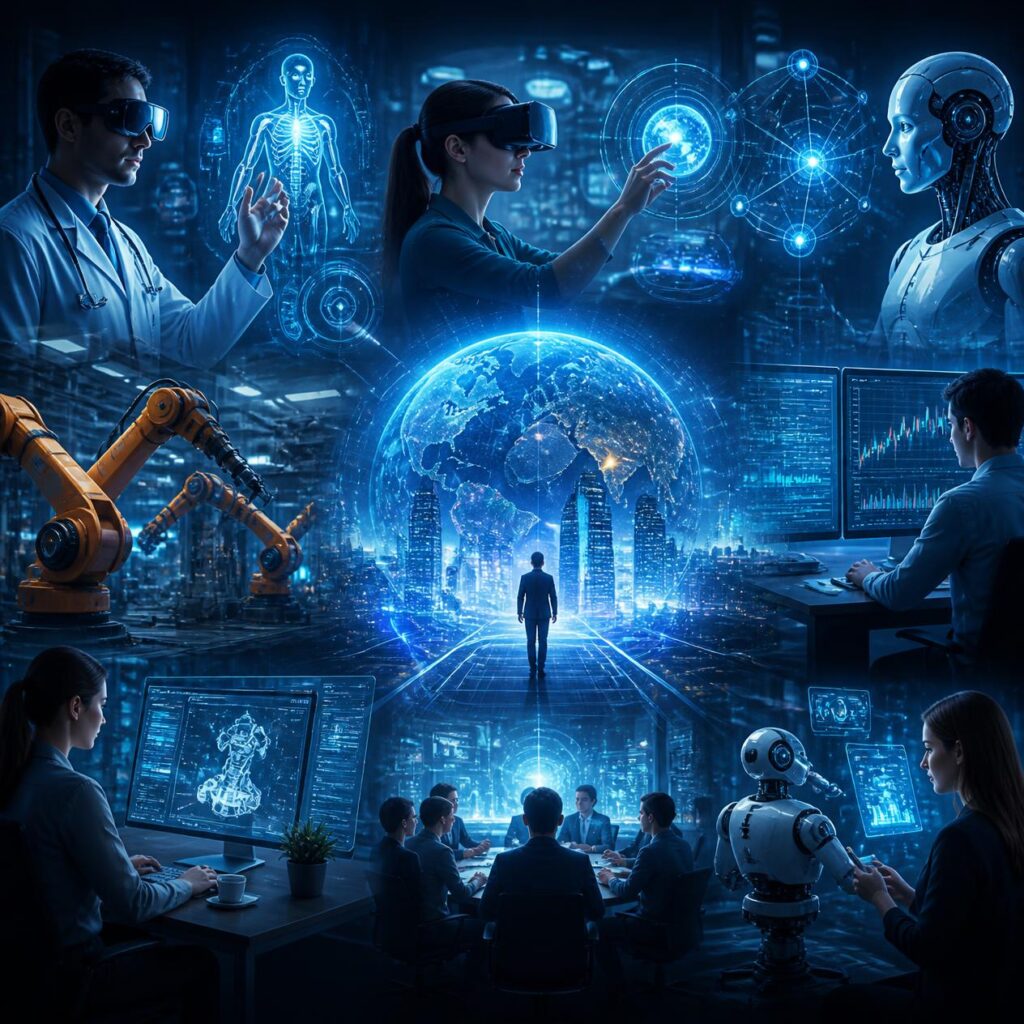
At its core, Artificial Intelligence is the ability of computer systems to perform tasks that normally require human intelligence. These tasks include understanding language, recognizing images, identifying patterns, solving problems, making predictions, learning from data, and generating entirely new content.
Unlike traditional software, which follows predefined rules written by developers, modern AI systems learn from enormous amounts of information. Instead of simply executing instructions, they identify relationships, improve their performance over time, and adapt to new situations. This shift from rule-based programming to data-driven learning represents one of the most significant technological transformations of the modern era.
Today’s AI ecosystem is far more diverse than many people realize. It includes technologies such as:
- Natural Language Processing (NLP), enabling machines to understand and generate human language.
- Computer Vision, allowing systems to recognize objects, faces, and environments.
- Machine Learning, where algorithms improve through experience rather than explicit programming.
- Deep Learning, using neural networks inspired by the human brain to solve highly complex problems.
- Generative AI, capable of producing text, images, videos, music, software code, and even scientific research assistance.
Among these technologies, Generative AI has become one of the defining innovations of 2026. Rather than simply analyzing existing information, these systems can create original content within seconds. A marketer can draft campaign ideas, a programmer can generate working code, a designer can explore multiple visual concepts, and a teacher can prepare personalized educational materials—all with AI acting as a collaborative assistant rather than a replacement.
This distinction is important because artificial intelligence should not be viewed as a substitute for human creativity or expertise. Instead, the most successful professionals are learning how to combine human judgment, critical thinking, and creativity with AI’s ability to process information at extraordinary speed.
In many ways, AI today resembles the early internet. During the 1990s, businesses that ignored the web gradually lost their competitive advantage. In 2026, a similar transformation is taking place with artificial intelligence. Individuals and organizations that learn how to integrate AI into their daily workflows are gaining measurable advantages in productivity, innovation, and decision-making.
However, adopting AI is not simply about using the latest tools. It requires understanding their capabilities, recognizing their limitations, and applying them responsibly. AI systems can generate impressive results, but they are not infallible. Human oversight remains essential for verifying facts, ensuring ethical use, protecting privacy, and maintaining quality.
As artificial intelligence continues to evolve, its greatest value may not lie in replacing human work, but in expanding what people are capable of achieving. Those who embrace AI as a partner—rather than viewing it as either a miracle solution or a threat—will be better positioned to thrive in the years ahead.
In the next section, we will explore why 2026 represents a turning point for artificial intelligence and examine the industries experiencing the fastest and most significant AI-driven transformation.
Why 2026 Is the Defining Year for Artificial Intelligence


While artificial intelligence has been evolving for decades, 2026 marks a unique moment in its history. For the first time, AI is no longer limited to researchers, large enterprises, or technology enthusiasts. It has become a practical, everyday technology that millions of people actively rely on to solve problems, save time, and improve the quality of their work.
Only a few years ago, many AI tools were experimental. They often required technical expertise, produced inconsistent results, or were too expensive for widespread adoption. Today, that landscape has changed dramatically. Modern AI platforms are faster, more accurate, easier to use, and accessible to individuals with little or no programming experience.
This shift has fundamentally changed how people approach work. Instead of replacing existing workflows, AI is increasingly becoming an intelligent layer that enhances them. Writers generate first drafts more efficiently, developers receive coding suggestions in real time, marketers analyze customer behavior within minutes, and designers transform rough ideas into polished visual concepts without spending hours on repetitive tasks.
One of the biggest reasons 2026 stands out is the rise of AI assistants. These systems are no longer simple chatbots that answer basic questions. They can reason through complex problems, summarize lengthy documents, analyze datasets, generate presentations, write software, and even collaborate on creative projects.
Think of AI today as a highly knowledgeable digital colleague rather than a search engine. Instead of simply providing links to information, modern AI systems can organize ideas, explain complicated concepts in plain language, compare multiple solutions, and adapt their responses based on context. This ability to interact naturally has significantly lowered the barrier to entry for people who previously found advanced technology intimidating.
AI Is Reshaping Every Major Industry
The influence of artificial intelligence now extends far beyond the technology sector. Nearly every industry is discovering new ways to integrate AI into its daily operations.
In healthcare, AI assists medical professionals by identifying patterns in medical images, supporting early diagnosis, and accelerating pharmaceutical research. While doctors remain responsible for final decisions, AI helps reduce the time required to analyze complex information and uncover insights that might otherwise be overlooked.
Education has also entered a new era. AI-powered learning platforms can personalize lessons based on a student’s strengths, weaknesses, and learning pace. Instead of following a one-size-fits-all curriculum, learners increasingly receive customized educational experiences that improve engagement and retention.
Software development has experienced one of the fastest transformations. AI coding assistants now help developers write cleaner code, detect bugs before deployment, explain unfamiliar programming concepts, generate documentation, and automate repetitive development tasks. Rather than replacing software engineers, these tools allow them to spend more time solving meaningful problems and designing innovative solutions.
Creative industries have undergone an equally significant evolution. Graphic designers, video editors, musicians, photographers, and content creators are using generative AI to explore ideas more quickly, experiment with multiple concepts, and accelerate production without sacrificing originality. Human creativity remains the driving force, but AI has become an efficient creative partner capable of handling repetitive or time-consuming processes.
Marketing professionals are leveraging AI to analyze customer behavior, identify emerging trends, optimize advertising campaigns, generate content, and improve audience targeting. Businesses of all sizes now have access to sophisticated analytical capabilities that were once available only to organizations with dedicated data science teams.
The Competitive Advantage Is No Longer AI—It’s AI Literacy
Perhaps the most important shift happening in 2026 is not technological at all—it is educational.
The competitive advantage is gradually moving away from simply having access to AI tools. Today, many of the world’s most powerful AI platforms are available to almost everyone. What truly differentiates successful individuals and organizations is their ability to use these tools strategically.
This growing skill is often described as AI literacy.
AI literacy involves understanding what artificial intelligence can do, recognizing where it performs well, identifying its limitations, asking better questions, verifying its outputs, and integrating AI into real-world workflows responsibly.
Professionals who develop these abilities are becoming significantly more productive than those who ignore AI entirely. Yet productivity alone is only part of the equation. The greatest benefit comes from combining human expertise with machine intelligence.
AI can process enormous volumes of information within seconds, but it lacks genuine human experience, emotional intelligence, ethical judgment, and contextual understanding. Successful collaboration occurs when humans guide the creative direction, make strategic decisions, and evaluate outcomes while allowing AI to automate repetitive analysis and execution.
As we move further into 2026, one thing is becoming increasingly clear: artificial intelligence is no longer a technology reserved for the future. It has become an essential digital skill—much like using the internet, email, or search engines became essential in previous decades.
The question is no longer whether AI will influence your career or business. It already does. The more important question is how effectively you choose to adapt, learn, and grow alongside it.
In the next section, we will explore the opportunities, challenges, and ethical questions surrounding artificial intelligence, and discuss how individuals and organizations can prepare for an AI-driven future with confidence.
The Benefits and Challenges of Artificial Intelligence
As artificial intelligence becomes more deeply integrated into everyday life, it is clear that its impact extends far beyond convenience. AI is changing how we solve problems, make decisions, create content, and interact with technology. However, like every major technological breakthrough in history, its rapid growth brings both extraordinary opportunities and important challenges.
Understanding both sides of the conversation is essential. Viewing AI as either a perfect solution or an existential threat oversimplifies a much more complex reality. The truth lies somewhere in between.
The Benefits: Smarter Tools for Smarter Work
One of the greatest strengths of artificial intelligence is its ability to process and analyze information at a scale that would be impossible for humans alone. A well-trained AI model can review millions of data points in seconds, identify hidden patterns, summarize complex documents, or generate multiple solutions to a problem almost instantly.
This capability is transforming productivity across nearly every profession.
For software developers, AI accelerates coding by suggesting functions, identifying bugs, explaining unfamiliar code, and automating repetitive programming tasks. Instead of spending hours searching documentation or debugging simple errors, developers can focus more on software architecture, problem-solving, and innovation.
In marketing, AI helps businesses understand customer behavior more accurately. Companies can analyze purchasing patterns, predict future demand, personalize advertising campaigns, and optimize content based on real user engagement. Even small businesses now have access to advanced marketing insights that previously required expensive analytics teams.
Creative professionals are also discovering new possibilities. Writers use AI to brainstorm ideas and overcome creative blocks, while designers generate multiple visual concepts in minutes. Video creators automate editing workflows, and musicians experiment with AI-assisted composition. Importantly, these tools do not replace creativity—they expand it by reducing repetitive work and giving creators more time to refine their ideas.
Education has become another area where AI is making a meaningful difference. Personalized learning systems can adapt lessons to each student’s pace, recommend additional resources, and provide instant feedback. Rather than replacing teachers, AI supports educators by allowing them to spend more time mentoring students and less time on administrative tasks.
Across these industries, the common advantage is not simply speed. It is the ability to make better-informed decisions by combining human expertise with intelligent data analysis.
The Challenges: Technology Requires Responsibility
Despite its remarkable capabilities, artificial intelligence is far from perfect. AI systems are only as reliable as the data they are trained on and the people who design, evaluate, and use them.
One of the most widely discussed concerns is accuracy. Large language models and generative AI systems can occasionally produce convincing but incorrect information, a phenomenon often referred to as AI hallucination. Because these responses may appear highly confident, users should never assume that AI-generated content is automatically accurate. Critical thinking and independent verification remain essential.
Privacy is another significant issue. Many AI applications process large amounts of user data to deliver personalized experiences. This raises important questions about data protection, transparency, and responsible handling of personal information. Organizations adopting AI must ensure that privacy is treated as a core principle rather than an afterthought.
Bias also deserves careful attention. AI models learn from existing data, and if that data contains historical biases or incomplete perspectives, the system may unintentionally reproduce those patterns. Developers, researchers, and organizations have an ongoing responsibility to improve fairness, test for unintended outcomes, and build systems that serve diverse communities responsibly.
There is also growing discussion about the future of work. While AI is automating certain repetitive tasks, history suggests that technological revolutions often transform jobs rather than eliminate them entirely. New roles emerge, existing professions evolve, and workers who continuously learn new skills tend to adapt successfully. In this environment, lifelong learning is becoming one of the most valuable professional investments anyone can make.
Ultimately, artificial intelligence should not be viewed as a replacement for human intelligence but as a powerful extension of it. The organizations and individuals who achieve the greatest success will be those who combine technical capability with ethical judgment, creativity, curiosity, and a commitment to continuous learning.
As AI continues to mature, the conversation will shift from what artificial intelligence can do to how humanity chooses to use it. That decision will shape not only the future of technology but also the future of society itself.
The Future of Artificial Intelligence Beyond 2026


If the past decade has taught us anything, it is that artificial intelligence evolves much faster than most predictions suggest. Technologies that once seemed experimental have become essential tools in business, education, healthcare, software development, and creative industries. Looking beyond 2026, the question is no longer whether AI will continue to advance—it is how deeply it will become integrated into every aspect of our lives.
One of the most significant developments will be the rise of AI agents. Unlike today’s AI assistants, which typically respond to individual prompts, future AI agents will be capable of managing complete workflows. They will plan projects, coordinate multiple software applications, monitor progress, identify potential problems, and execute complex tasks with minimal human intervention. Rather than serving as simple assistants, they will function as intelligent digital collaborators.
Another major trend is the growing importance of multimodal AI. Modern systems are already capable of understanding text, images, audio, and video simultaneously. Future models will combine these capabilities even more seamlessly, allowing users to interact naturally through conversations, sketches, voice commands, documents, and live video. This will make technology significantly more intuitive and accessible for people regardless of their technical background.
Artificial intelligence is also expected to become increasingly specialized. Instead of relying solely on general-purpose AI models, businesses will adopt industry-specific systems trained for fields such as law, medicine, engineering, finance, architecture, and scientific research. These specialized models will provide deeper expertise while reducing errors and improving reliability.
At the same time, regulation will play a much larger role. Governments, technology companies, and international organizations are already developing frameworks to encourage responsible AI development. Transparency, accountability, copyright protection, cybersecurity, and data privacy will become essential components of every successful AI strategy. Organizations that prioritize ethical AI practices will likely earn greater public trust and long-term competitive advantages.
Perhaps the most exciting opportunity lies in the relationship between humans and machines. For many years, discussions about AI focused on automation and job displacement. Increasingly, however, the conversation is shifting toward augmentation—using artificial intelligence to enhance human capabilities rather than replace them.
The professionals who thrive in the coming years will not necessarily be those with the deepest technical knowledge, but those who know how to ask better questions, evaluate AI-generated results critically, and combine technology with creativity, empathy, and strategic thinking. These uniquely human qualities will remain invaluable even as AI becomes more sophisticated.
Key Takeaways
Artificial intelligence in 2026 is no longer a futuristic concept—it is a practical technology shaping nearly every industry.
Its greatest value lies not in replacing human intelligence but in expanding what people can accomplish through collaboration with intelligent systems.
Organizations that invest in AI literacy, ethical implementation, and continuous learning will be better prepared for long-term success.
At the same time, responsible use of AI requires transparency, human oversight, data privacy, and a commitment to verifying information rather than accepting machine-generated output without question.
Ultimately, artificial intelligence should be viewed as a powerful tool. Like every transformative technology before it, its impact depends on how wisely we choose to use it.
Conclusion
Artificial intelligence has reached a pivotal stage in its evolution. It is no longer confined to research laboratories or global technology companies. Today, AI is helping entrepreneurs launch businesses, enabling students to learn more effectively, supporting healthcare professionals, accelerating software development, empowering designers, and transforming how organizations make decisions.
Yet technology alone does not create progress. Real innovation happens when human curiosity, experience, and creativity work together with intelligent machines.
As we move beyond 2026, success will belong to individuals and organizations that embrace lifelong learning, remain adaptable, and understand both the possibilities and responsibilities that accompany artificial intelligence. The future of AI is not simply about smarter algorithms—it is about creating a future where technology amplifies human potential rather than replacing it.
Whether you are a developer, business owner, student, designer, marketer, or simply someone curious about the future, there has never been a better time to begin exploring the world of artificial intelligence. Those who start learning today will be the ones shaping tomorrow.
Frequently Asked Questions
1. What is Artificial Intelligence in simple terms?
Artificial Intelligence is the ability of computer systems to perform tasks that typically require human intelligence, such as understanding language, recognizing images, solving problems, learning from data, and generating new content.
2. Why is AI so important in 2026?
AI has become widely accessible and is now integrated into everyday work, education, business, healthcare, and creative industries, making it one of the most influential technologies of our time.
3. Will AI replace human jobs?
AI will automate certain repetitive tasks, but it is also creating new roles and increasing demand for skills such as critical thinking, creativity, problem-solving, and AI literacy.
4. Is Artificial Intelligence always accurate?
No. While AI systems can produce highly valuable insights, they may occasionally generate incorrect or misleading information. Human review and fact-checking remain essential.
5. What skills are most valuable in an AI-driven future?
AI literacy, digital communication, critical thinking, creativity, adaptability, ethical decision-making, and continuous learning are among the most valuable skills for the future workforce.
6. How can beginners start learning AI?
Beginners can start by exploring AI-powered tools, taking introductory online courses, experimenting with prompt engineering, and understanding the practical applications of AI across different industries.
Final Thought
Artificial intelligence is not replacing human potential—it is redefining it. The future belongs to those who remain curious, continue learning, and use AI as a tool to solve meaningful problems, create new opportunities, and build a smarter, more innovative world.